


Roughly one in three U.S. households rent their home, according to the Census Bureau’s most recent housing data — a group that skews notably younger than homeowners and has been the fastest-growing segment of the housing market over the past year. That’s a meaningful chunk of the country making Halloween decorating decisions under a different set of constraints than the typical decorating advice assumes, and it’s worth designing a renter friendly decorating shopping approach around that reality rather than ignoring it.
Table of Contents
The Real Numbers Behind Who’s Renting Today
The U.S. Census Bureau’s Housing Vacancies and Homeownership report puts the national homeownership rate at 65.7% as of the most recent quarter, meaning roughly 34.3% of U.S. households rent. That’s not a small or fringe group — it’s over a third of the country, and separate analysis of Census data found that rental households drove roughly four out of five new household formations over the past year, meaning the renting population isn’t just large, it’s actively growing faster than the homeowning one.
That growth rate is worth sitting with for a moment. Rental household formation significantly outpaced owner-occupied household formation over the same period, which means the share of the country renting isn’t a stable, unchanging third — it’s a group that’s expanding relative to homeowners, driven partly by elevated mortgage rates and reduced affordability for first-time buyers. A national homeownership rate that once trended upward for decades has, in recent years, plateaued and modestly declined, which is part of the broader context behind why renter friendly decorating has become a more relevant category than it might have been a decade ago.

The age split matters just as much as the raw numbers. Renters are considerably younger on average than homeowners — homeownership among adults 25 to 34 sits well below where it was two decades ago, and renters as a group skew under 40 by a wide margin. That’s directly relevant to renter friendly decorating specifically, since younger, newer households are also the demographic most likely to be actively decorating for the season for the first time, without years of accumulated seasonal decor already on hand.
Why This Matters for Renter Friendly Decorating Specifically
Renting typically comes with real constraints that homeownership doesn’t: security deposits tied to the condition of walls and paint, lease clauses restricting adhesive or permanent alterations, and in many cases, less certainty about staying in the same unit next Halloween. None of that makes renter friendly decorating impossible — it just means the calculus around adhesive-based or wall-mounted decorations is genuinely different for a third of the country than it is for the two-thirds who own.
Security deposits specifically create a category of financial risk that simply doesn’t exist for homeowners decorating their own walls. A homeowner who damages paint while removing a decoration faces, at most, a future repainting cost they control the timing of. A renter facing the same damage risks a deduction from a deposit that could otherwise be returned in full — a cost that’s both less predictable and less within their control. That asymmetry is a big part of why renter friendly decorating deserves its own framework rather than being treated as a subset of general Halloween decorating advice.
Our no-damage Halloween decorating guide already covers this tradeoff in general terms. This piece takes it a step further by mapping specific products already reviewed on this site against that renter friendly decorating framework, since knowing the general principle is less useful than knowing which specific purchases actually fit it.
The No-Damage Product Lineup for Renter Friendly Decorating
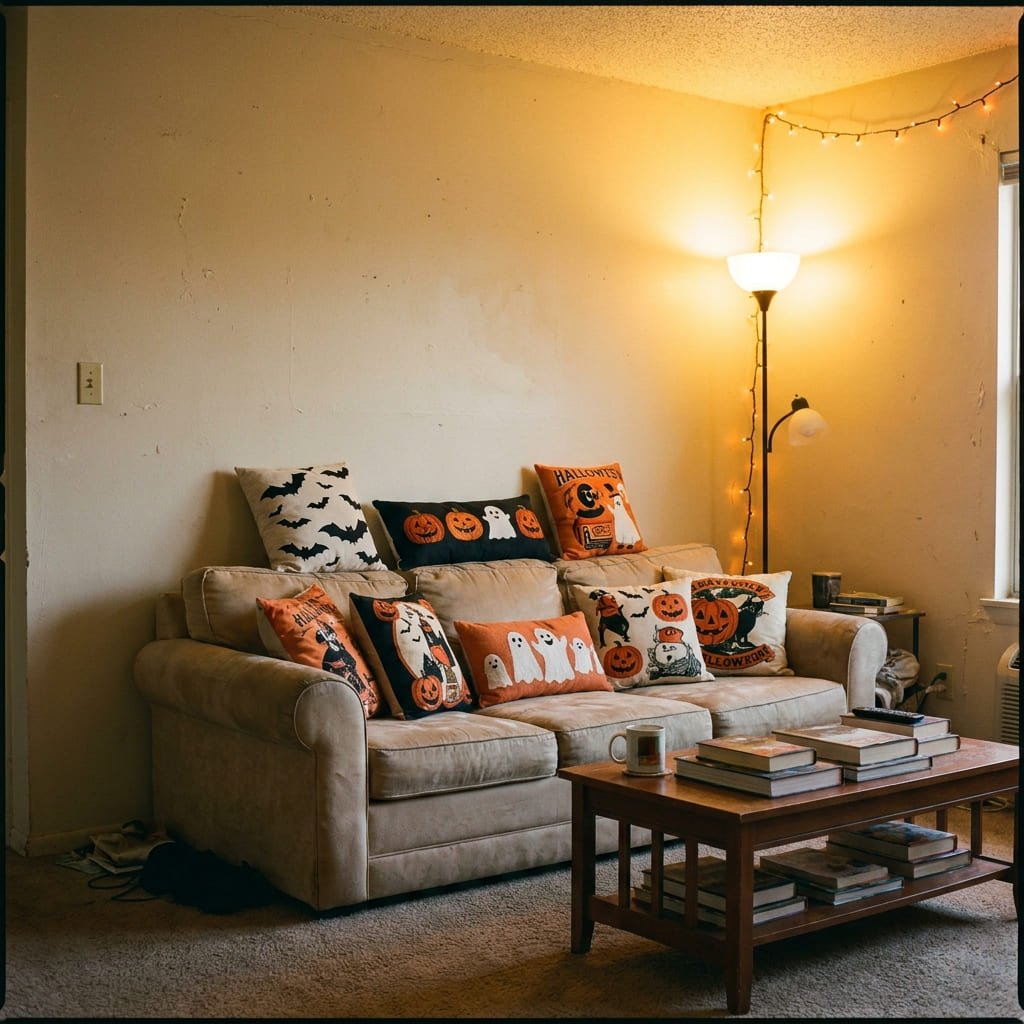
Not every Halloween product carries the same risk profile, and it’s worth being specific rather than treating “decorations” as one undifferentiated category. Our Halloween pillow covers review covers what may be the single lowest-risk category available: a fabric swap with zero wall contact, zero adhesive, and a removal process that’s just unzipping a cover. For anyone renting, this is about as close to zero-risk seasonal decorating as the category gets.
Exterior pieces occupy a similarly safe tier. Our Halloween mailbox cover review and coir doormat review both cover products that sit on or around existing fixtures rather than attaching to anything permanent, making them reasonable renter friendly decorating picks regardless of lease terms.
The picture gets more nuanced with adhesive-based decorations. Our bat wall decor review covers a genuinely well-reviewed product that still carries a real, documented paint-removal risk on certain surfaces — the kind of risk that matters more for renters specifically, given how directly it can affect a security deposit. That review includes specific guidance on safer removal technique, which is worth reading in full before using anything adhesive-based in a rented space.
Timing plays a role in this decision too. A renter who knows they’ll be moving before next Halloween has less reason to invest in a permanent-feeling decoration in the first place, regardless of removal risk, while a renter who expects to stay in the same unit for years might reasonably treat a well-executed adhesive product differently than one who’s uncertain about their lease renewal. This kind of practical, individual context matters more for renter friendly decorating decisions than a single blanket rule ever could.
A Practical Shopping Approach by Risk Tier
Given the numbers above, it makes sense to think about Halloween decorating purchases in three tiers rather than treating every product the same way. The zero-risk tier includes anything that doesn’t touch a wall at all — pillow covers, doormats, mailbox covers, and similar swap-in accessories. The low-risk tier includes adhesive products specifically designed for safe removal, used with the careful technique covered in our bat wall decor review. The higher-consideration tier includes anything more permanent — actual paint, wallpaper, or structural additions — which is reasonably outside the scope of seasonal decorating for most renters entirely.
This tiered approach to renter friendly decorating isn’t about avoiding risk entirely — it’s about matching the level of risk to the level of commitment a purchase actually deserves. Starting with the zero-risk tier and only moving to the low-risk tier once you’re confident in the removal technique is a reasonable default for anyone uncertain about their specific lease terms or landlord’s expectations, since the cost of guessing wrong falls disproportionately on the tenant rather than the property.
Pets are worth a specific mention here too, since Halloween decorating and pet costuming often get planned together. Our cat bat wings costume review covers an accessory that carries essentially zero property risk, since it never touches a wall or fixture at all — a useful example of how the renter friendly decorating framework extends beyond just home decor into pet-related purchases too.
What the Spending Data Suggests About This Group
Our Halloween spending roundup already covers this year’s national data showing decorating tied as the single most common way people celebrate. It’s a reasonable inference that a meaningful share of that spending is happening within exactly the constraints covered here, given that roughly a third of all households are renting under some version of the restrictions discussed above.
That context reframes the growing popularity of no-damage decorating categories — pillow covers, doormats, removable accents — as something closer to a structural trend than a niche preference. As rental households continue to grow faster than the homeowning population, demand for genuinely no-damage seasonal decor is a reasonable thing to expect more of, not less, in the years ahead.
It’s also worth noting what the spending data doesn’t directly show: whether renters and homeowners are actually spending differently on Halloween decorating, since the national survey doesn’t break results out by housing tenure. What can be inferred, though, is that the category of product growing in relevance — genuinely no-damage, removable decor — maps closely onto a demographic that’s growing in size, which is a reasonable signal for where seasonal decorating demand is headed even without a direct renter-specific breakdown in the underlying survey data.
What to Actually Check Before Buying
None of this replaces reading an actual lease. Some rental agreements are more permissive than others about temporary decorations, and some landlords are considerably more flexible in practice than the strict letter of a lease might suggest. The risk-tier framework above is a reasonable default for anyone who hasn’t checked, but a five-minute read of the actual lease language — or a quick question to a landlord or property manager — is a better source of truth than any general renter friendly decorating guide, including this one.
Move-out inspection standards are worth understanding too, since they vary considerably by property. Some landlords document existing wall condition thoroughly at move-in, which gives a tenant more room to argue against unfair deposit deductions; others document less, which shifts more of the burden onto the tenant to prove a mark existed before they moved in. Knowing which situation applies before committing to any adhesive-based decoration is a genuinely useful piece of renter friendly decorating due diligence, and it’s the kind of renter friendly decorating research that costs nothing but a few minutes of checking old photos or paperwork.
Frequently Asked Questions
What percentage of U.S. households actually rent? According to the most recent U.S. Census Bureau data, the homeownership rate is 65.7%, meaning roughly 34.3% of households rent — a little over one in three, which is the core statistic behind this entire renter friendly decorating framework.
Are renters actually a growing share of the housing market? Yes. Recent analysis of Census data found that rental household growth significantly outpaced homeowner household growth over the past year, with renters accounting for roughly four out of five new households formed.
What’s the safest category of Halloween decoration for a rental? Fabric-based swaps that never touch a wall — like pillow covers, doormats, or mailbox covers — carry essentially no property risk, since there’s no adhesive or permanent contact involved at all. This is the foundation of most renter friendly decorating approaches.
Can renters still use adhesive-based Halloween decorations safely? Often yes, with the right technique. Slow, careful removal and testing on an inconspicuous spot first meaningfully reduces the risk, though it’s still a higher-risk category than fabric-based alternatives within a renter friendly decorating framework.
Why does the age of renters matter for Halloween decorating specifically? Renters skew younger and are more likely to be decorating for the first time without years of accumulated seasonal decor already on hand, which makes the specific products they choose to start with more consequential for their overall approach to the holiday.
The Bottom Line on Renter Friendly Decorating
Renter friendly decorating isn’t a niche concern — it’s a reasonable framework for roughly a third of the country, and that share has been growing rather than shrinking. Thinking about seasonal purchases by risk tier, starting with genuinely zero-risk categories like pillow covers before considering anything adhesive-based, is a practical approach that works regardless of whether you rent or own, but matters considerably more for the growing share of households who do.
None of this requires treating Halloween decorating as more complicated than it needs to be. The underlying logic of renter friendly decorating is simple once it’s laid out clearly: start with what carries no risk at all, understand the tradeoffs before adding anything with real removal risk, and let the specific details of your own lease and landlord relationship guide anything beyond that baseline.
Housing statistics cited in this article come from the U.S. Census Bureau’s Housing Vacancies and Homeownership quarterly report and supporting analysis of Census data on household formation trends.
[…] hanging methods across rented properties can explore comprehensive strategies in our guide to Renter-Friendly Halloween Decorating. Implementing non-destructive mounting techniques allows apartment residents to build ambitious […]
[…] across interior and exterior doors can explore non-destructive mounting strategies in our guide to Renter-Friendly Halloween Decorating. Implementing damage-free attachment methods ensures full landlord compliance while preserving […]